
An established casino has a brand, search traffic, and loyal returning customers. A three-week old casino has none of this, and has to compete for the same customers with the only tool they have available - the welcome offer. This is why the largest package offers adopted by the market are generally found at the newest sites. In this case, the offer is the marketing budget. What is more interesting to consider, however, is who picks up the tab for the ad, and the terms documents found on our new casinos ranking will provide you with the answer.
The bonus is an acquisition cost
Casino welcome bonuses are priced the same way as any other customer acquisition cost. The expected cost of the welcome offer must be less than the expected value of the customer the offer attracts. When calculating a welcome bonus the expected cost is usually a tiny percentage of the headline offer. The mechanics behind the offer (wagering base, win caps, time limits, etc) offset the payout substantially. A "$5,700 package" that few players complete, and that is capped when they do, costs a fraction of its face value. The headline is real only in the sense that it illustrates how badly the casino wants you, and how much a new offering needs you more than anyone.
What our roster shows: scores down, numbers up
Comparing the advertised packages of the casinos we reviewed against our ratings shows a clearly defined pattern:
| Casino | Score | Advertised welcome | Wagering maths |
|---|---|---|---|
| Beazt | 8.7 | 100% up to $500 | Published, bonus-only base, worked example in the terms |
| SpinSkull | 6.9 | EUR 1,200 + 1,200 spins over 6 deposits | Published: 25x deposit+bonus, 48h per stage |
| Bitguruz | 5.3 | 300% up to $3,000 + 300 spins | Published: 30x deposit+bonus |
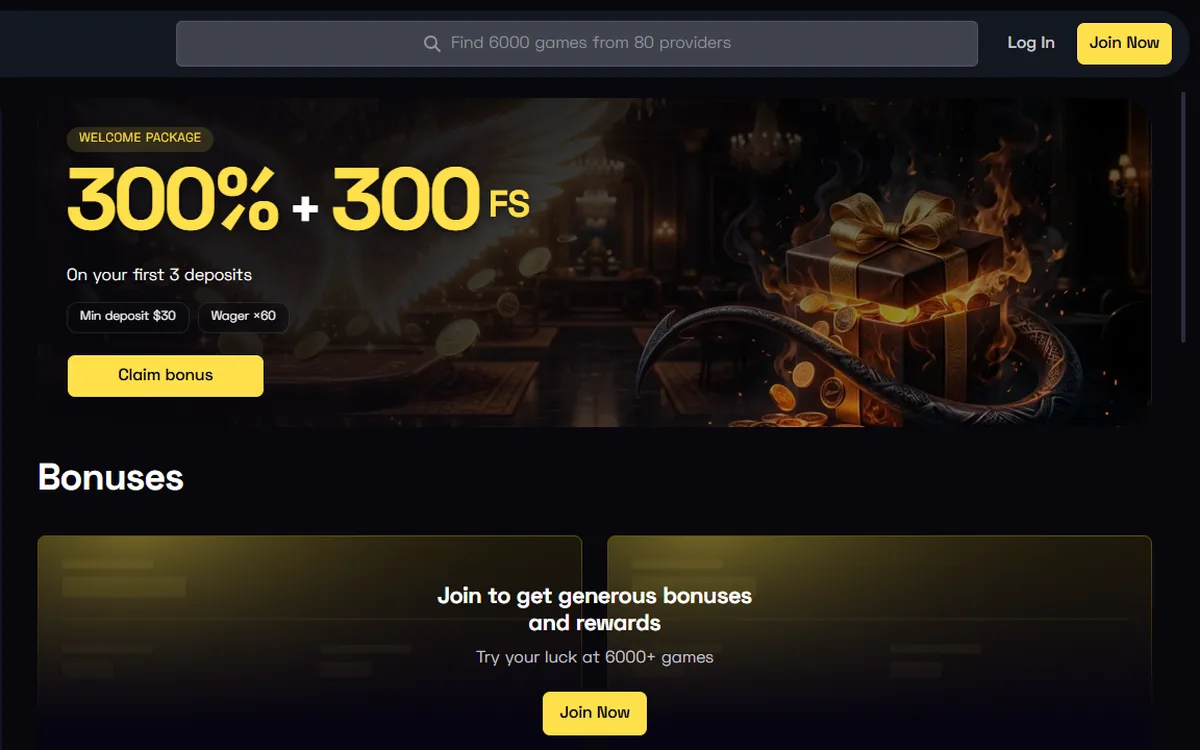
| OreonBet | 5.0 | 300% + 300 spins | Behind the login |
| SpinEmpire | 4.9 | "10 Welcome Bonuses", four-figure headline | No public terms at all |
| Zizobet | 4.4 | 550% up to $5,700 + 900 spins | No wagering figure anywhere on the site |
| Golisimo | 3.7 | 300% up to $3,750 + 300 spins | Published: 35x deposit+bonus per stage |
Offers as advertised on each casino's own pages, captured 27 August 2026. The full pricing of each sits in the linked reviews.
There are two trends in that table worth noting. First, the best performer from a ratings perspective advertises the least amount - Beazt's modest 100% match comes with mechanics you can price to the penny. Second, the bigger the ad, the more likely the price is missing: of the biggest packages we reviewed, three keep their wagering terms unpublished or behind a login. The number gets larger as the maths gets quieter, and that correlation is the single most useful thing we learned pricing this group.
How a big number is made cheap
The design behind a 550% headline and what it really costs, mechanism by mechanism:
- Summed packages. Zizobet's 550% and Golisimo's 300% are four deposit matches added together. Nobody receives 550% of anything; each stage matches its own deposit, and each stage demands its own qualifying deposit.
- Tier holes. The stages carry separate exits: at Zizobet a fourth deposit under $800 earns nothing, and a missed login day forfeits the remaining spins. Every hole is a percentage of players who deposit for a stage and get no bonus from it.
- The combined wagering base. As the wagering guide shows in detail, multiplying deposit plus bonus roughly doubles the turnover behind the same advertised number. Most of the big packages on our roster use it.
- Win caps. Whatever the package produces, release caps of 5x-10x the deposit decide what leaves - the caps guide maps them across the roster. A capped bonus has a maximum cost to the casino, printed in its own terms.
- Clocks and ceilings. Five-day windows and $5 maximum bets make completion mathematically demanding, and every incomplete run costs the casino nothing at all.
The substitution effect
There is a second reason launch bonuses run big, and it is less innocent than marketing budgets. A bonus is the one trust signal money can buy instantly. A licence takes months; a payout track record takes years; a 550% banner takes an afternoon. On our roster, the correlation runs through the paperwork: Casinos with verified licences and named operators advertise moderate offers, compared to the no-name, no regulator end of the spectrum, where sites naming no owner, or failing their own seal checks, advertise the largest offers. When a site has nothing verifiable to show you, the bonus is doing the showing.
When a big bonus is genuinely good
None of this means that offering large packages is a bad thing. It is offering packages with zero price that is a bad thing. A large package grabs your attention when it clears 5 important bars:
- The wagering figure and its base are published on the offer page, logged out. Zizobet fails this bar with the biggest headline on our roster.
- The base is the bonus alone, or the deposit-plus-bonus maths still prices acceptably after you run it.
- The caps are disclosed - release cap, spin-winnings cap, and whether either persists.
- The window survives division. Turnover divided by days must be a pace you would actually play at.
- The casino itself checks out - because a great offer at a site that fails licence and complaints checks is a great offer from a counterparty you cannot hold to it. WinSpin is our standing example of a big number done transparently: EUR 5,000 advertised, every mechanic published, and the caps stated where you can read them. Every current launch offer is compared under these rules on our new casino bonuses page.
Bonus economics FAQ
Which new casino has the best welcome bonus?
The best offer is the one you can price, and the biggest offer, is not always the best, on our current roster. Beazt caps its deal at $500 and publishes an example and a base, whereas WinSpin publishes every single detail of their offer, including caps. The offer with the biggest number published on our roster, publishes no wagering figure at all, which removes it from the comparison entirely.
Why do new casinos give such big bonuses?
Customer acquisition. A launch has no brand, no search presence, and no returning customers. This means the welcome package is the only form of marketing, and so it is priced at a level where the expected value of the customers is greater than the expected cost of the package. The wagering bases, win caps, time limits, and the stage rules help reduce the expected cost to a value that is significantly less than the headline of the offer.
Are big casino bonuses a scam?
A published big bonus is an aggressive but readable deal. The problem cases are packages that are priced in four figures but have no wagering requirement. Offers priced in four figures with terms hidden behind a login or with terms that vary with different players, are unpriced offers, and we documented all of these examples on real sites. An offer that pricing is hidden for, should be considered to be priced at a value that you should not want to pay.
Should I always take the welcome bonus?
No - declining is usually the better trade, and a few casinos price that in. Deposits at most roster sites can be played bonus-free with far fewer strings, but check for deposit-wagering clauses first. One casino on our roster skips welcome bonuses entirely and pays rakeback instead, which is ideal for players who never want to meet a wagering requirement.
Play responsibly
 Play responsibly
Gambling is entertainment with a cost, never a way to make money. A welcome package is engineered spending: four deposits dressed as one gift, each a separate decision your budget has to survive. Set a ceiling for the operation before stage one, and treat every bonus as spending, not income.
If play stops feeling like a choice, free and confidential help is available at Gambling Therapy and BeGambleAware. This site is for adults 18 and over.
Guide by Adrian Voss, published 31 August 2026. All offers and mechanics quoted from each casino's own published pages, captured 27 August 2026; the acquisition-economics framing is analysis, and every factual claim in it is anchored to those captures. Changelog: 31 Aug 2026 - body copy rewritten for readability; the figures and findings are unchanged. 31 Aug 2026 - first version.