
Terms and Conditions contracts place important clauses at the end and fill the first few pages with unimportant procedures and processes. Reading them that way is exactly what the corporate lawyers want. This method goes against that. Open the document, use the search function, and do the six most important jumps. You'll probably know more than the customer support desk in ten minutes.
Read with search, never linearly
Open the full terms page and as you make the jumps search for these words, "Company", "law", "jurisdiction", "fee", "commission", "dormant", "wagering", "maximum", "void", "pending", "business days", "calendar month", "complaint", "verification". Fourteen searches will help you navigate through about two hundred pages of roster terms. One thing to note, however, is that some casinos have terms and conditions that load in sections. So, search after expanding everything that might be hidden. Two rostered sites had a collapsed section that housed an important clause.
Jump 1: the definitions - who is "the Company"?
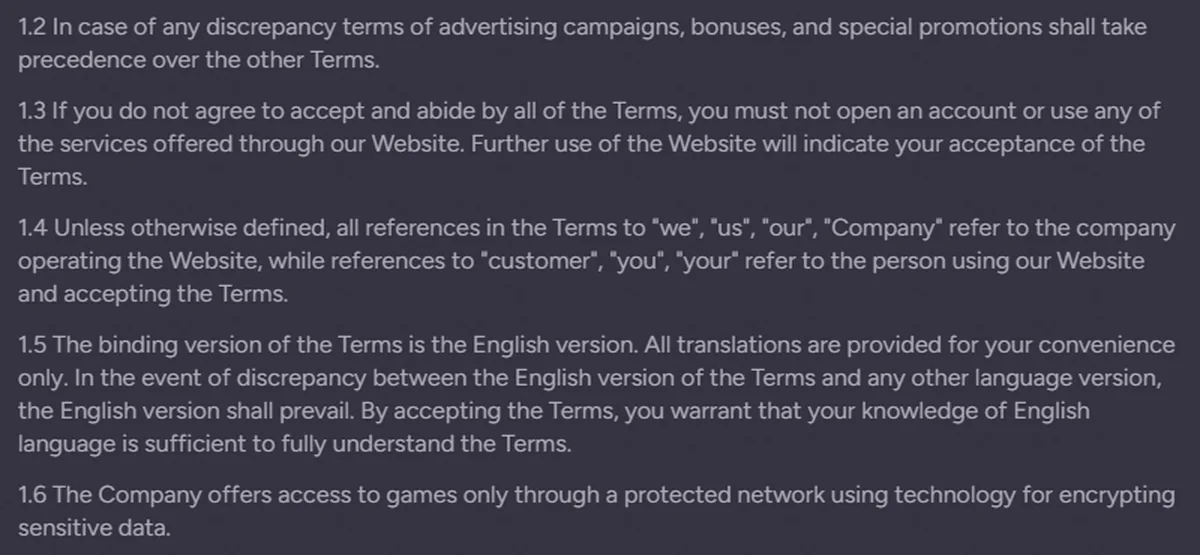
Minute one: the most important sentence in the document, the operator clause. In Beazt it is a company name, a registration number and an address. In Wintino and Golisimo, clause 1.4 describes the company as "the company operating the Website". This is a circle with no name. In CoinCasino and Bombastic, the named company is a string of registry digits trading as a name. Whatever else the document may say, this clause indicates who has an obligation to you when you win. In the case where nobody can be identified, the other thirty-nine pages are footnotes.
Jump 2: governing law - where could a dispute even happen?
Search for "law" and "jurisdiction", usually found at the end of the document. Zizobet names the courts of Curacao; OnlyWin names Curacao law and courts. The twins' documents state disputes are to be resolved "in accordance with the applicable Law" - which law is never said - and the entire applicable-law section in BigClash's document is blank. A contract that is unable to state where it is, is essentially telling you what your legal position is: nowhere.
Jump 3: the money clauses - fees, dormancy, thresholds
Search for "fee", "commission" and "dormant". This is where deposits become obligations: commissions of 8-25% on lightly wagered deposits, monthly dormancy charges, balances lapsing after a year, and minimum-activity thresholds that can block a withdrawal. Our red flags guide catalogues all twelve instances of these requirements published by casinos - this is where ten of the twelve reside.
Jump 4: the bonus annex - the base sentence and the caps
Look for the bonus policy (usually located on a separate page). Focus on two points. Look for the base sentence: does the wagering requirement multiply the 'bonus amount' or 'deposit and bonus'? That wording roughly doubles the cost, as the wagering guide illustrates with one casino's own banner. Look for the ceilings: the maximum amount that can be withdrawn as a result of the bonus and the maximum amount that can be bet while the bonus is active - the caps guide covers both of these. If the offer you were shown has no public terms, as we documented for two casinos located on the roster, this ends our reading.
Jump 5: the withdrawal section - the exit schedule
Look for "pending", "business days", and "maximum". You are looking for four values: the daily and monthly allowances at entry level, the limit for pending requests, and the processing window, as well as the working hours of the cashier desk. Together they are the timetable any win actually pays out on. The withdrawal limits guide illustrates the impact of a large win against the real ladders on the roster, and it is quite concerning.
Jump 6: complaints, read backwards
Look for the complaints clause and read from the last to the first. The last step is the system: a named ADR body, a regulator's dispute portal, or the casino's own committee. Note the time periods during which a dispute can be filed (three days for one casino on the roster) and the caps on the liability along the way. The disputes guide has the six endings we documented and their respective values.
The seventh read: the version stamp
Before closing the document, take a look at the version line "Version 1.12, Last update: 19.08.2026" and similar lines. That earns thirty seconds twice over. The latest date stamp on the document helps bound the casino's age claims and hence helps validate the checks in our licence number decoder. And an identical date stamp on two "separate" casinos is perhaps the best single indicator of a platform twin, as the twin spotting guide demonstrates with two example pairs. Write the date stamp down along with your signup date. Casinos change documents, and that note will be the only record of the version you agreed to.
What a good document looks like
Reading twenty of these documents in a week will help you distinguish good documentation and bad documentation. There are a few distinguishing features of good documentation: an operator's name and registration number in clause one, the applicable jurisdiction, fees listed in a table containing numbers, a bonus policy that shows its base and works an example (Beazt will perform the calculation for you on a small deposit, in their own terms), and a complaints provision that ends outside the building. These documents appear on our rankings, which is why the alternative is a choice, not an industry standard.
The ten minute budget: definitions, one minute, governing law, one minute, money clauses, two minutes, bonus terms and conditions, two minutes, withdrawals, two minutes, complaints, one minute, version stamp, thirty seconds. What remains will buy you a scan of anything your searches flagged. Set a timer once; after three casinos you will beat it.
Reading casino terms FAQ
Do I really need to read casino terms and conditions?
They are the six clauses that outline who the operator is, what law applies, what the costs of making a deposit are, what the real conditions of the bonus are, what the rules are for making withdrawals and where the complaints are lodged. Every expensive surprise we found across twenty casinos is located in one of the six clauses, and all of the six clauses are visible in any terms and conditions page.
What is the most important clause in casino terms?
Here is the definition of "the Company". It identifies your counterparty, the party that owes you the money when you win and speaks when things go wrong. In our list, it can range from a name that is registered and verified by a regulator to the statement "the company running the Website". Everything else in the document is important based on that answer.
Can casino terms change after I sign up?
Yes - they include the version number on documents to show that the document has been revised. Most of the terms and conditions allow for their updating. Record the version and date when you sign up, take a screenshot of the offer for a bonus when you receive it, and ensure you keep both. If there is a disagreement on what rules apply, then yours are the only version records that you control.
What if the terms are hidden or incomplete?
Treat missing text as an answer. In our list, we found a jurisdiction section that renders empty, bonus packages without published terms, and cashier rules located behind a login. A document that you are not able to read before making a deposit is a cost that you only learn about after making the deposit, and the casinos that publish everything show that there is no reasonable basis for the gaps.
Play responsibly
 Play responsibly
Gambling is entertainment with a cost, never a way to make money. Reading the terms tells you the price; it cannot make the price worth paying. Set a ceiling before you deposit anywhere, and treat every bonus as spending, not income.
If play stops feeling like a choice, free and confidential help is available at Gambling Therapy and BeGambleAware. This site is for adults 18 and over.
Guide by Adrian Voss, published 31 August 2026. Every clause cited is quoted from the published terms of the casino named, captured 27 August 2026; the six-jump routine is the method used, in this order, for all twenty reviews on this site. Changelog: 31 Aug 2026 - body copy rewritten for readability; the figures and findings are unchanged. 31 Aug 2026 - first version.